Every telecom operator talks about network transformation and network automation. Annual reports for telcos globally emphasise billions being invested in growing, maintaining, managing and evolving their networks. That makes sense. Telecommunications companies are known as network operators. But network builds only happen when customers and associated revenues justify the investment.
Networks don’t generate revenue on their own.
Revenue is generated when network capabilities are packaged, sold, delivered, measured, billed, supported and renewed correctly. That entire commercial lifecycle is governed by a network operator’s Business Support System (BSS).
In practical terms, BSS is the revenue engine of any network operator.
So, what exactly do the BSS do in telecom environments that makes them so commercially critical?
At its core, a Business Support System manages the entire commercial lifecycle of customer services. BSS manage everything from product configuration and service activation through to billing and payment collection, turning network capabilities into revenue.
BSS tend to be customer-facing systems, giving subscribers a method of accessing the network (in the form of telecommunication services).
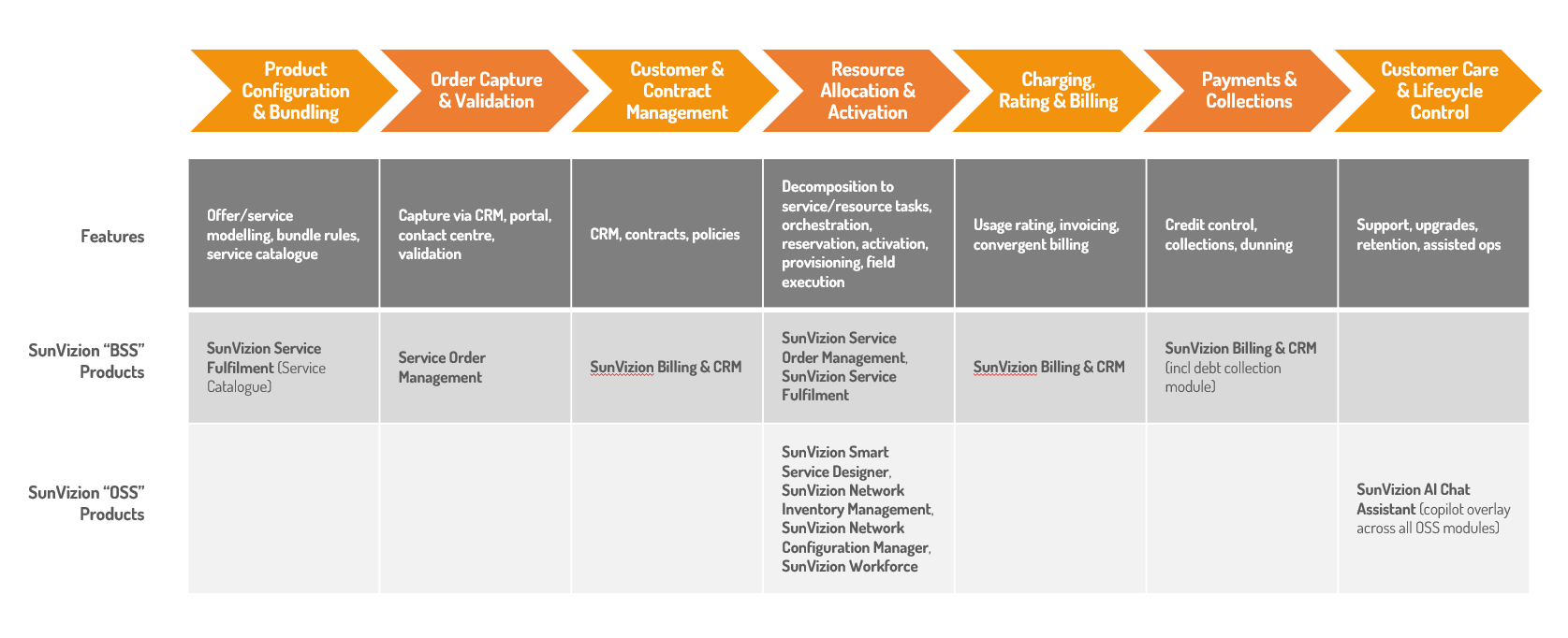
Below is a 7-step journey that defines what activities a BSS manages in practice.
Turning Network Capabilities Into Sellable Products - Where Revenue Begins
The first responsibility of a business support system is product modelling. Networks deliver capabilities such as bandwidth, connectivity, QoS profiles, SIM activation, fibre access and much more. But customers buy structured offers, bundles and price plans, also known as Products.
This is where the product catalogue becomes a critical part of a BSS. Using tools such as SunVizion Smart Service Designer, operators can define commercial products, pricing models, eligibility rules and discount structures in a well governed way.
If product governance is weak, inconsistencies propagate downstream into order validation, billing errors and disputes. In contrast, a well-structured catalogue reduces time-to-market for new services and ensures every offer is monetisable from day one.
Capturing Orders and Controlling Commercial Risk
Once offers are defined, the next step in the telecom BSS is Orders. Order capture and validation to be more precise.
This stage answers the key question above - what do BSS do in telecom? The Order Management of a BSS enforces commercial rules before services are activated. Order capture, across any ordering channel (e.g., online, call centre, partner), must consistently validate the customer request, eligibility, pricing combinations and contractual terms. Orders may originate from multiple channels, including digital self-service portals, enterprise customer portals, partner channels and traditional call centres.
With SunVizion Service Order Management, operators can orchestrate commercial orders and ensure data consistency across systems.
Integration with SunVizion Network Inventory verifies resource availability and service feasibility before activation. Once validated, the BSS decomposes the commercial order into service and resource tasks that are executed by OSS systems responsible for provisioning and network configuration. This tight coupling between BSS and OSS reduces order fallout, prevents failed activations and protects customer experience.
By controlling validation at this stage, operators avoid activating services that cannot be billed correctly, delivered on time or serviced on an ongoing basis, which are common sources of hidden revenue leakage, time delays and customer angst.
Before services are activated, telecom BSS platforms also manage customer accounts, contracts and policies. This includes maintaining customer hierarchies, contract terms, service-level agreements (SLAs) and account governance across consumer, enterprise and wholesale customers.
Platforms such as SunVizion Billing & CRM maintain the customer record of truth, ensuring that all orders, services and billing events are tied to the correct contractual and commercial agreements.
Charging and Billing Without Revenue Leakage
For many operators, billing is where the telecom BSS system becomes most visible to customers. In some cases, the bills are the only interactions a customer has with their operator after telco services have been activated effectively.
Charging and rating logic calculate recurring fees, usage-based charges and one-off costs based on network usage records and commercial product rules. In convergent environments, where charges are aggregated across mobile, fibre, TV, etc on a single invoice, the complexity of the bill increases significantly.
SunVizion Billing & CRM supports accurate rating, invoice generation and customer account management in a unified environment. This ensures that every configured product translates into correct charges on the invoice.
However, modern telecom business support systems must go further than invoice generation. They must embed revenue assurance feedback loops. Disputes, adjustments and anomalies should feed back into catalogue rules and order validation logic, creating a closed control system to ensure customer satisfaction and systematic coordination.
When implemented correctly, this step directly impacts KPIs such as dispute rate, days sales outstanding and order fallout rate. In other words, BSS is not just administrative - it is financial control infrastructure.
Managing Payments, Care and the Customer Lifecycle
The final part in the 7-step BSS journey extends beyond billing.
Payment processing, credit control, collections and dunning processes determine cash flow health.. Effective customer and service lifecycle management handles upgrades, downgrades, contract renewals and service changes without manual rework.
Through integration with SunVizion Service Fulfilment and SunVizion Workforce, commercial changes can automatically trigger operational tasks, whether via automated provisioning or physical intervention by the field workforce.
This alignment between business support system logic and operational execution reduces churn, improves right first-time fulfilment and helps deliver on key performance indicators such as ARPU (Average Revenue Per User) across the customer lifecycle.
Defining BSS Through Its Commercial Impact
So, as we’ve discovered a business support system is not just billing software. It’s not just CRM. It’s not just order entry.
The BSS telecom meaning becomes clear when viewed through the entire 7-step journey:
- Product Configuration & Bundling
- Order Capture & Validation
- Customer & Contract Management
- Resource Allocation & Activation
- Charging, Rating & Billing
- Payments & Collections
- Customer Care & Lifecycle Control
Together, these steps form the commercial backbone of OSS/BSS solutions that operationalise and monetise a telecom operator’s network assets.
In competitive markets, the difference between growth and margin erosion often lies in how well these seven stages are integrated and governed.
If you want to understand where revenue leakage may be hiding in your organisation, or how to modernise your telecom BSS as part of a broader OSS/BSS transformation, contact SunVizion to explore how an integrated, modular approach can protect revenue and accelerate time-to-market.
