Every telecom operator depends on physical assets such as cables, ports, racks and towers. But when those assets are not accurately recorded, even simple service changes or fault diagnoses can become difficult (which means slow, expensive and risky). Physical inventory is not just documentation, it’s the operational foundation of modern telecom OSS.
What does physical inventory mean in telecom?
In telecom, physical inventory refers to the real-world network assets that can be located, identified and linked to one another in a structured way. These are the tangible components that support service delivery, such as fibre cables, ducts, manholes, cabinets, racks, patch panels, ports, towers and customer termination points.
This is why the phrase physical inventory telecom is more than a simple asset register. A proper telecommunications network inventory does not just list equipment. It records where each asset is, how it is built, what it is connected to, and how it fits into the wider network structure. In practice, that means a network physical inventory system should capture location, hierarchy, capacity, connectivity and status.
For telecom operators, this physical view is essential because network operations always lead back to something tangible. A service may be ordered digitally and activated through software, but it still depends on real infrastructure in the field.
6 examples of physical inventory across a telecom network
The easiest way to understand physical inventory meaning in telecom is to look at examples, starting with the diagram below.
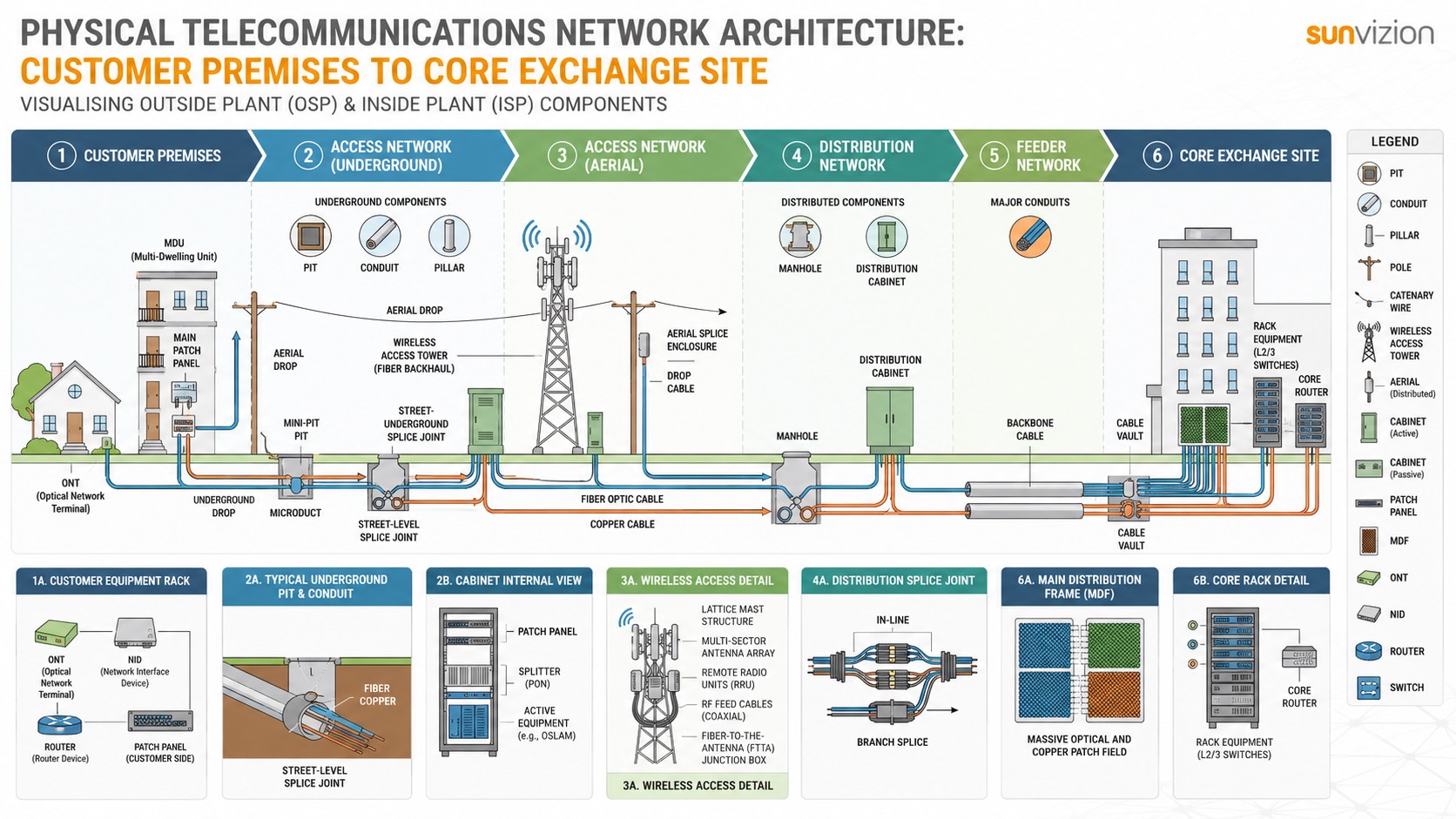
First, there are the customer premises components, where the physical network meets the end user. In the diagram, this starts with the ONT (Optical Network Terminal), NID (Network Interface Device) and customer router or CPE (Customer Premises Equipment), or via a patch panel in MDU (Multi-Dwelling Unit) environments. These NTDs (Network Termination Devices) forms the physical demarcation point between the telecommunications network inventory (i.e., carrier or service provider) and the customer environment.
Next, the network moves into the various types of Access Network:
· Access network (underground). Here, physical inventory includes the pit, conduit, pillar, mini-pit, microduct and underground drop, as well as the street-level splice joints. These are used to connect fibre or copper segments. Without accurate records of lead-ins, pits, conduits, splice locations and underground routes, rollout and repair work becomes far more difficult.
· Access network (aerial). In this part of the physical inventory network, operators need to track the pole, catenary wire, aerial drop and related overhead cable paths. These elements are especially important in networks where the final connection to buildings (the lead-in) is delivered above ground rather than through ducts.
· Access network (wireless). Here, physical inventory includes the comms tower (communications tower), and attachments such as sector antennas, RF (Radio Frequency) feeder cables, cabinets and associated site infrastructure. It also relies on the major feeder cable routes (also known as backhaul links) running through high-capacity conduits between network sections. In mobile and converged networks, this tower and feeder information is essential for rollout, upgrades and ongoing operations.
Then the topology reaches the distribution network, where physical inventory becomes more concentrated around connection and aggregation points. This includes the manholes / chambers, distribution cabinets / pillars, and additional splice points. At this stage, operators also need visibility into detailed connectivity, such as individual splices or connections, as well as elements such as the patch panel and splitter arrangements within cabinets. These are some of the most important items in telecom inventory management because they represent the points where connections from hundreds or even thousands of homes are aggregated.
Finally, the chain ends at the core exchange site, where physical inventory includes cable vaults, backbone and feeder cable entry points, rack equipment, patch panels, MOF (Main Optical Frame) and MDF (Main Distribution Frame). These act as termination points for the cable network. These are generally patched to routers or voice switches that terminate the optical or electrical signals, which originated at the CPE in the customer premises. The exchange also houses racks, shelves, down to slots and ports. These become especially important, because operators must know the exact physical location of each device and connection in order to manage capacity, maintenance and service delivery effectively.
Taken together, these examples show that telecommunications network inventory is not limited to one physical asset type or one network domain. It spans customer premises, underground / aerial / wireless access, distribution and core exchange facilities. This links every physical component into connected chains to service customer connectivity needs.
Physical inventory vs logical inventory. What is the difference?
A common question is how physical inventory vs logical inventory should be understood.
Physical inventory describes the tangible assets in the network. Logical inventory describes the services, configurations and virtual relationships that are carried over those assets. For example, a fibre cable is physical inventory, while the routed service path (from CPE to core router) over the fibre is logical inventory. A port on a device is physical, while the service assignment or VLAN configured against that port is logical.
Both views matter. Without physical inventory, operators cannot see the real infrastructure supporting a service. Without logical inventory, they cannot understand how services are configured, connected and delivered across the infrastructure. Strong telecom OSS depends on linking both together.
Why physical inventory matters for telecom operations
Accurate physical inventory supports better service fulfilment because teams can identify the correct assets and available capacity before assigning resources. It also improves fault isolation, since operations teams can trace problems back to specific cables, ports or sites instead of relying on fragmented records. It also helps with customer notifications when a known outage is being resolved.
Physical inventory also matters in planning and rollout. New fibre builds, mobile upgrades and network expansions all depend on data that can be trusted to represent what actually exists in the field. If the physical record is incomplete, or inaccurate, planning decisions become slower and less reliable.
This is also where network automation begins. Automation works best when it can rely on accurate, structured data. If the physical layer is poorly documented, automated processes will be unreliable no matter how capable the automation platform is.
What to look for in a network physical inventory system
A modern network physical inventory system should do more than store asset names. It should model relationships between assets, track changes across the lifecycle and provide visibility across fixed, mobile and enterprise domains. It should also integrate with planning, fulfilment and assurance processes so that inventory becomes part of daily operations rather than a disconnected reference database.
Solutions such as SunVizion Network Inventory Management help operators build a trusted operational view by linking physical and logical resources in one environment. This creates a stronger foundation for telecom inventory management, network automation and more efficient OSS processes.
Learn more: https://www.sunvizion.com/products/network-inventory
Contact SunVizion: https://www.sunvizion.com/contact
