SunVizion Service Inventory is a service-centric module that helps telecom operators model, verify, activate, and manage the services they sell—while keeping every service instance tightly connected to the real network resources that deliver it. It bridges the gap between the business view of services (what you offer and sell) and the technical reality (what must be reserved, configured, and maintained in the network), so teams can move from “customer order” to “service running” in a controlled, repeatable way.
Unlike a simple service list, SunVizion Service Inventory captures the service structure, its lifecycle, and its dependencies on physical and logical assets. This gives you the operational clarity needed to scale service delivery, reduce fulfillment errors, and answer one of the most important questions in daily operations: “Which network resources are used by this service—and which services will be impacted if something fails?”
From product catalog to real service delivery
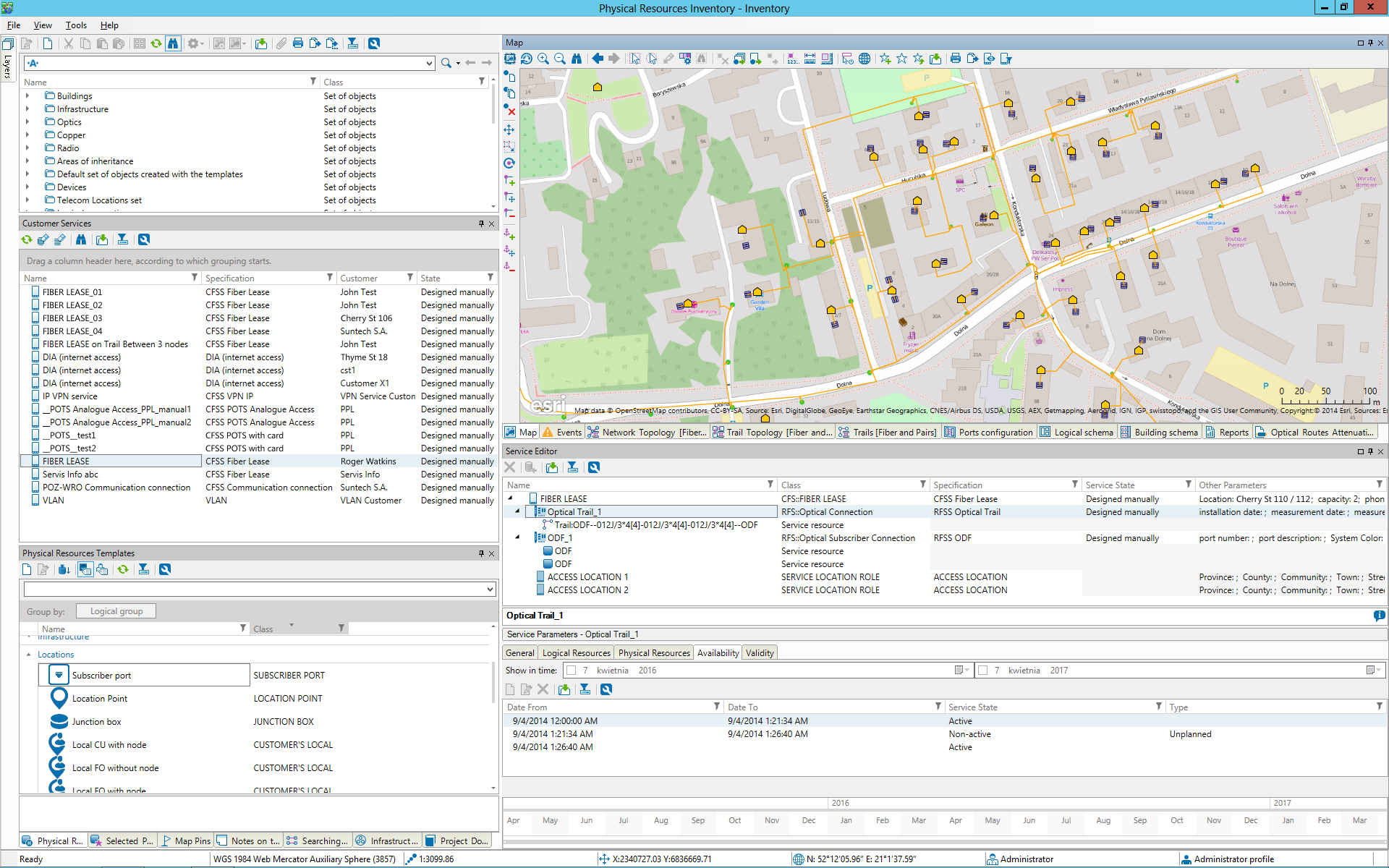
Service Inventory lets you build and maintain a catalog of customer-facing services (CFS) and define how each service decomposes into resource-facing services (RFS) that map directly to physical and logical resources managed in Resource Inventory.
In practice, this means you can model services the way the business sells them—clear, customer-friendly offers—while still capturing the technical composition that engineering and operations require. A single customer product can translate into a structured set of technical elements such as ports, addressing, bandwidth allocation, logical paths/trails, and physical connectivity. This structured modeling makes service delivery more predictable, and it reduces reliance on “tribal knowledge” that lives only in the heads of experienced engineers.
Automated feasibility checks before you commit
Before provisioning starts, SunVizion supports a service design and feasibility stage that verifies whether the service can be provided in a specific location and under the requested parameters. Instead of accepting an order and discovering constraints later, the system helps validate feasibility up front.
Typical automated checks may include:
- availability of the right ports and interfaces,
- availability of IP address pools and configuration prerequisites,
- reachability/coverage and network constraints for the requested location,
- rule-based validation aligned with your internal standards.
This is especially valuable in real-world environments where network capacity changes daily and where multiple teams touch the same resources. By confirming feasibility early, operators reduce failed installations, avoid repeated field visits, and improve customer experience from the first interaction.
Resource booking, allocation, and structured activation
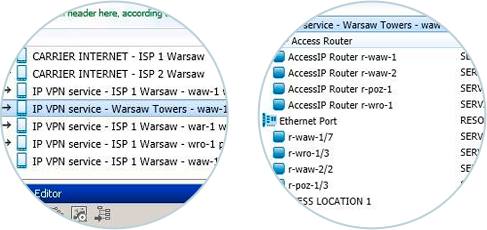
Once feasibility is confirmed, Service Inventory supports booking and allocation of the network resources required to deliver the ordered service. This includes reserving scarce resources (so they cannot be taken by another order) and assigning the exact elements that will implement the service in the network.
Depending on your process and automation level, the module can help:
- reserve ports and allocate throughput,
- assign IP resources and other configuration components,
- create service instances with a clear hierarchy of components,
- prepare the service structure for downstream activation workflows.
For more complex scenarios—where manual work is required (e.g., installation or special configuration)—the service record still remains the “control point.” Tasks can be executed by the right teams, and the service can progress through its lifecycle with traceable steps and clear ownership.
Full traceability from service to resources, and back again
One of the most operationally powerful capabilities is bidirectional traceability:
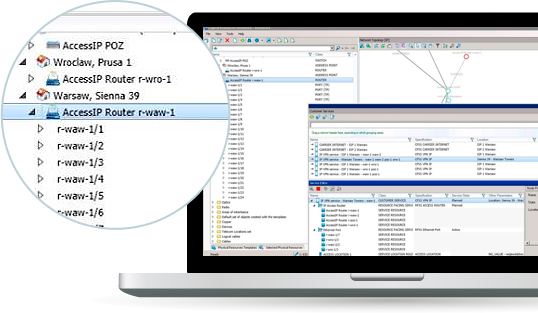
- Start from a service and drill down to the resources used to deliver it.
- Start from a physical or logical resource and immediately see which services depend on it.
This changes how teams work day-to-day. Engineers can implement changes with more confidence, operations teams can troubleshoot faster, and customer service teams can answer queries based on facts rather than assumptions. For complex services, SunVizion can also present the structure visually—showing the service composition and its mapping to resources in an easy-to-understand diagram view.
Service impact visibility during failures
Because services are explicitly mapped to network resources, SunVizion can indicate which services are affected when a network resource fails. This is the kind of insight that typically requires manual correlation across multiple systems—but here it becomes part of the service record itself.
That has a direct operational impact: customer service teams can provide accurate information to subscribers, operations teams can prioritize restoration based on real service impact, and the organization can communicate outages more transparently and consistently.
Service quality reporting with unavailability history
Service Inventory stores a history of unavailability for each service, enabling reliable service quality reporting over time. This supports SLA and quality monitoring by providing consistent data for reporting, audits, and continuous improvement initiatives.
Over time, this historical view helps identify recurring patterns (e.g., frequent interruptions related to a specific part of the network), supports root-cause analysis, and makes service performance measurable in a way that is easy to share internally and externally.
