SunVizion Logical Network Inventory helps telecom operators and infrastructure providers manage the logical side of the network—how bandwidth, channels and services are carried across transmission layers such as IP/MPLS, Ethernet, WDM and SDH/PDH. It gives you a clear view of network topology, capacity, and utilization, so you can quickly find available paths, reserve resources, and understand how changes or failures affect customers and services.
If your network data is scattered across NMS tools, spreadsheets, and diagrams, SunVizion brings it into one consistent, searchable model that is built for everyday engineering and operations.
See the full logical network topology—by technology layers
SunVizion organizes your transport and IP network into logical layers, where each layer contains:
- Nodes representing real network elements and their interfaces
- Links representing logical connections between nodes
- Bandwidth information, including total capacity and current utilization
This makes it easy to answer practical questions like:
- Which route has enough free capacity for a new customer connection?
- Where is the congestion building up?
- Which links and ports are already booked?
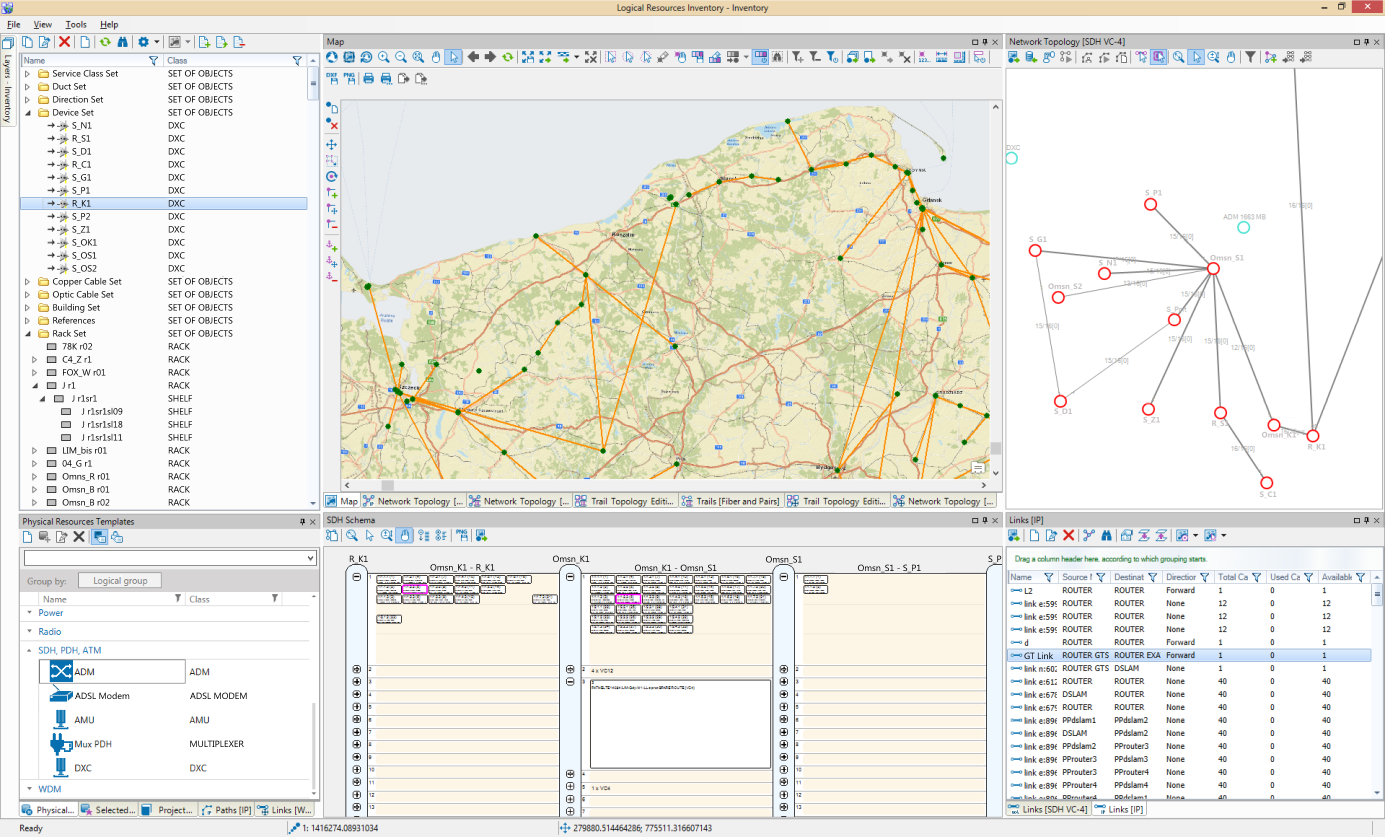
Capacity visibility and easier reservation of network resources
Logical Network Inventory provides a real-time view of network occupancy / utilization. Connections can be searched, checked for availability, and reserved without manual cross-checking across multiple systems.
This is especially valuable for:
- backhaul and transport networks with shared capacity,
- wholesale and leased lines,
- multi-layer networks where capacity in one layer depends on another.
Logical trails: track end-to-end connections and who is using them
SunVizion stores logical trails, which represent end-to-end capacity usage across a sequence of links—for example a transport trail that carries a higher-layer service.
Trails can represent:
- internal transport used by the operator,
- trails leased to customers (including other operators),
- trails leased from third parties (with interconnect elements modeled in the network graph).
Each trail can include route, termination points, status (available, reserved, leased, defective), duration, and commercial context such as customer/contract/SLA data—so you can manage both existing services and future reservations in one place.
Automated path finding to speed up provisioning and reduce errors
Trails can be created manually, but SunVizion also supports automated routing algorithms that help you find:
- the shortest path,
- the least-cost path,
- an alternate path (including routes without common elements),
- multiple candidate paths based on filters (required nodes, number of paths, technology constraints such as WDM wavelengths).
This helps teams provision faster and improve utilization by making better routing choices.
Map logical services to physical infrastructure
SunVizion allows you to map physical resources (such as cables or channels) to logical layers, so you can understand what a logical service is actually using underneath.
This gives you end-to-end visibility—from a logical connection down to the real infrastructure that carries it—and supports better engineering decisions for upgrades, migration and resilience planning.
Inter-layer associations: understand dependencies and single points of failure
A key strength of SunVizion is the ability to connect layers into a dependency stack—for example:
- fiber layer → WDM → SDH/PDH → Ethernet/IP → customer services
These inter-layer associations make it possible to trace dependencies “up and down” and identify:
- shared lower-layer resources used by multiple services,
- potential Single Points of Failure (SPOF),
- whether backup paths are truly diverse at the lower layers.
This is essential for designing resilient networks and for accurate impact assessment during incidents.
Failure impact analysis using alarms from fault management systems
When SunVizion receives alarms from Fault Management or Network Management systems, it can use topology and inter-layer dependencies to determine:
- how far the failure propagates across layers,
- which logical trails, services and customers are affected,
- what the downstream consequences are—often with visual support on the map.
This improves incident response, prioritization and customer communication.
Built for multi-technology transport and IP networks
SunVizion Logical Network Inventory supports the technologies commonly used in modern telecom networks, including:
- WDM (DWDM/CWDM/OTN) with capacity and trail management
- SDH/PDH with topology, utilization and protection visibility
- Ethernet and IP/MPLS with interface-level inventory and connectivity
It is designed for real-world networks where different technologies coexist and depend on one another.
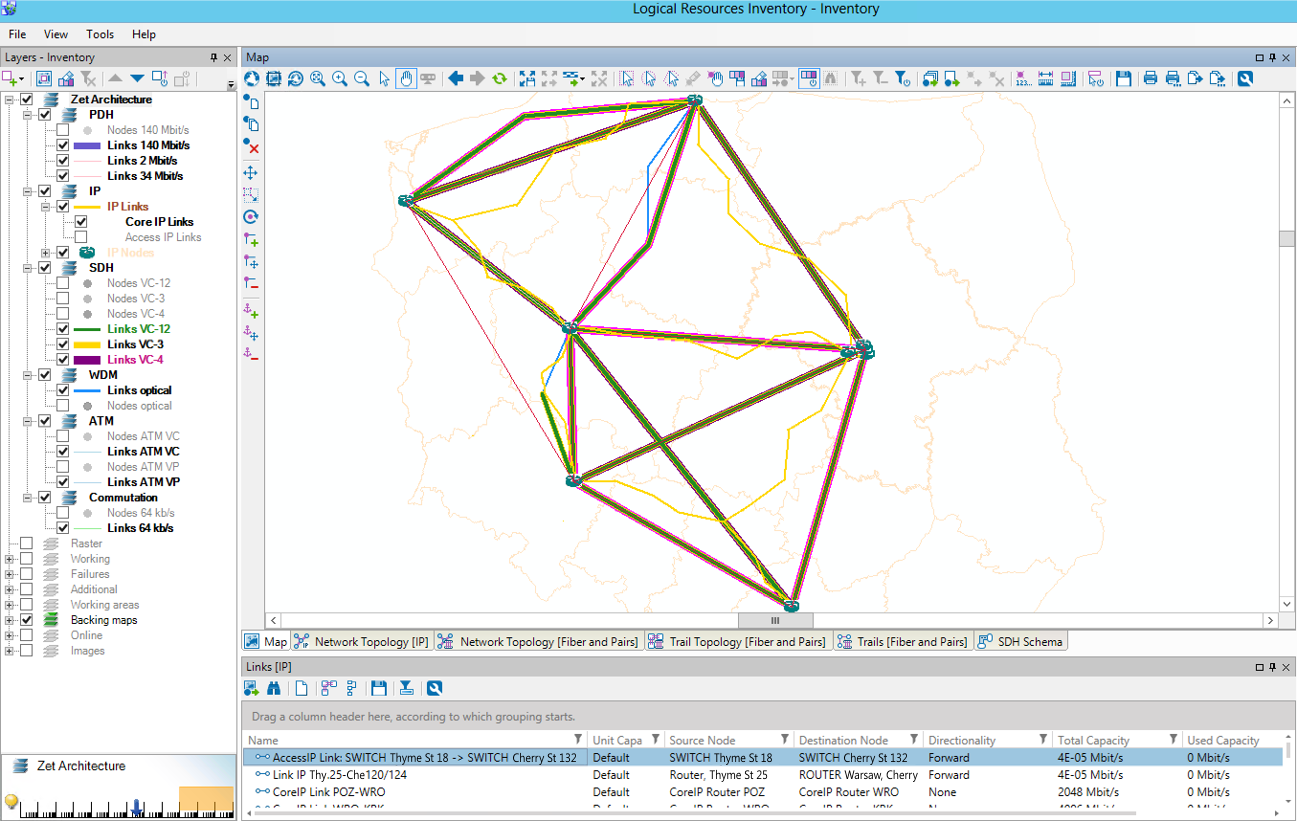
Works best together with SunVizion Physical Network Inventory
Logical Network Inventory becomes even more powerful when combined with SunVizion Physical Network Inventory, because logical topology can be linked to real infrastructure such as fiber cables, ducts, ports and sites—giving you a complete end-to-end view from map to service.
